
Coach using the GROW model
Updated March 2026
Introduction
In the course of Google's research on managers, we have learned that one of the most important behaviors of the highest scoring managers was that they were effective coaches. This is seen in other professions, as well. For example, in sports, many former athletes can tell stories about how a coach changed their life by identifying strengths, unlocking their potential, and encouraging them to persevere. You can help managers be effective coaches by encouraging them to focus on the individual needs of each team member. It is also important for managers to be able to flex their coaching styles — for example, the needs of individual team members may require them to be a “teaching” coach where the manager passes along an expertise to achieve something concrete, or a “facilitating coach” where the manager asks questions and listens instead of telling or giving answers.
Google is continuously researching what makes a good manager, and coaching still tops the list. Shannon Shaper, Director of People Analytics at Google, shares how coaching helps managers create the conditions for an effective, high-performing team.
Link to Youtube Video (visible only when JS is disabled)
Across the coaching continuum, here are some more tips to share with your managers:
- Have regular 1:1s with your team member and be fully present and focused on the team member.
- Be aware of your own mindset and that of the team member.
- Practice active listening and ask open-ended questions to facilitate the team member’s own insight (questions that start with “what” and “how” encourage expansive thinking).
- Provide specific and timely feedback.
- Balance positive (motivational) and negative (constructive) feedback and understand the unique strengths and development areas of each team member.
Below, Brian Glaser, Vice President and Chief Learning Officer at Google, shares the mindset shift that challenges managers to “listen to learn” not “listen to fix” when engaging with their team.
Link to Youtube Video (visible only when JS is disabled)
Coach with the GROW model
GROW is a simple framework developed in the United Kingdom and is one of the tools Google uses to teach managers about coaching conversations. It is used to guide managers in their coaching conversations with direct reports. This model stresses the importance of adapting and flexing coaching styles based on the team member’s needs and receptiveness. Generally, the GROW model is effective when:
The Team Member (employee)
- wants to be coached
- chooses their own challenges or issues to discuss
The Coach (manager)
- reflects on their own assumptions
- facilitates a two-way discussion
- structures the conversation towards some resolution
- knows when to stop giving advice and lets the team member choose their next steps
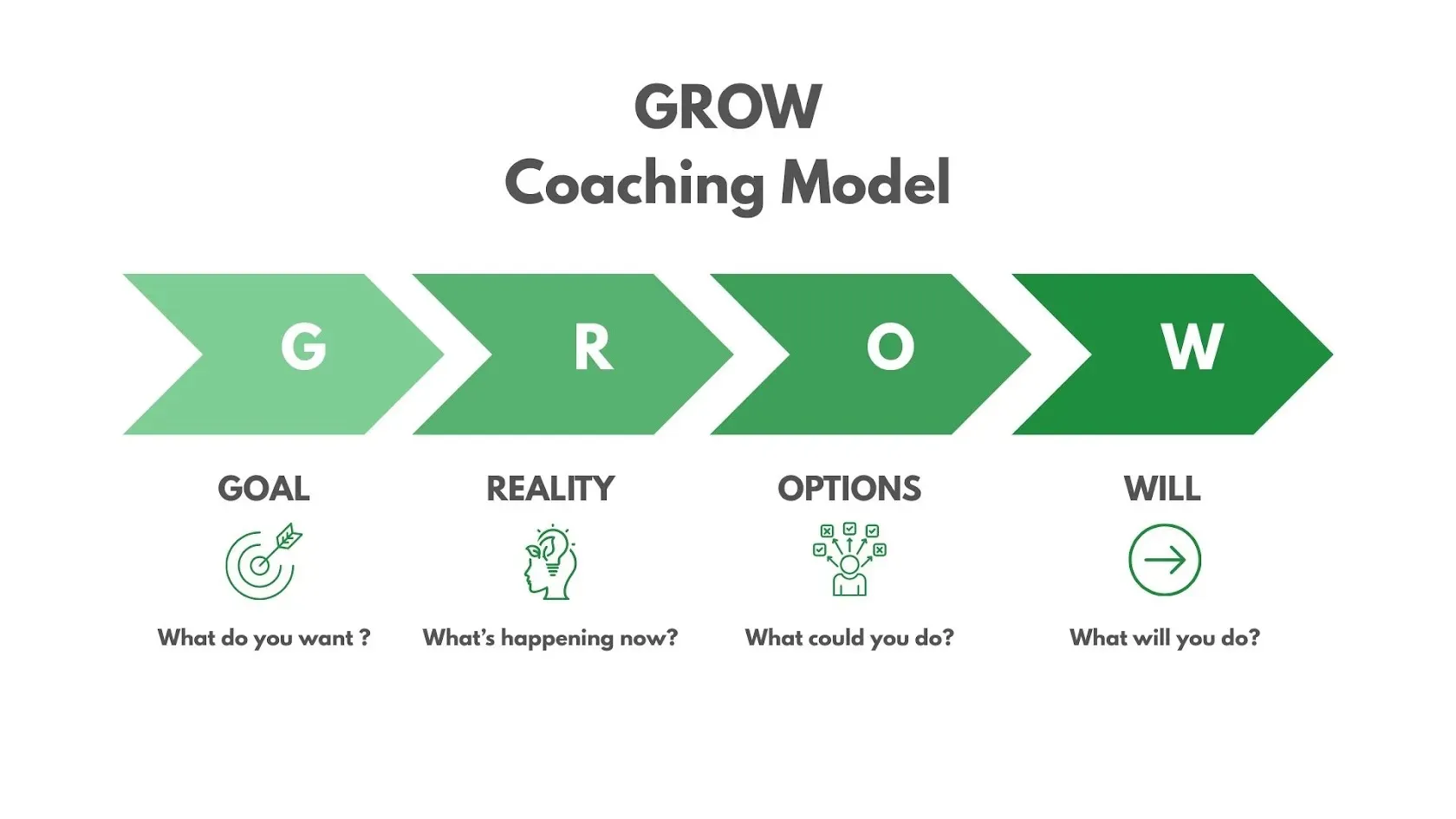
The GROW model provides managers with a simple, four-step framework to structure coaching conversations, guiding team members from identifying an initial goal to committing to a clear course of action.
True leadership means moving beyond oversight to empowerment. Using the GROW model, managers can transition from being “fixers” to “facilitators,” unlocking their team's potential to navigate challenges independently. Encourage your leadership to start small — perhaps by focusing on active listening in their next 1:1, or trying a "facilitating" approach during a challenge. With consistent practice and the right tools, coaching becomes more than just a management task; it becomes the foundation of a high-performing, self-sufficient team.